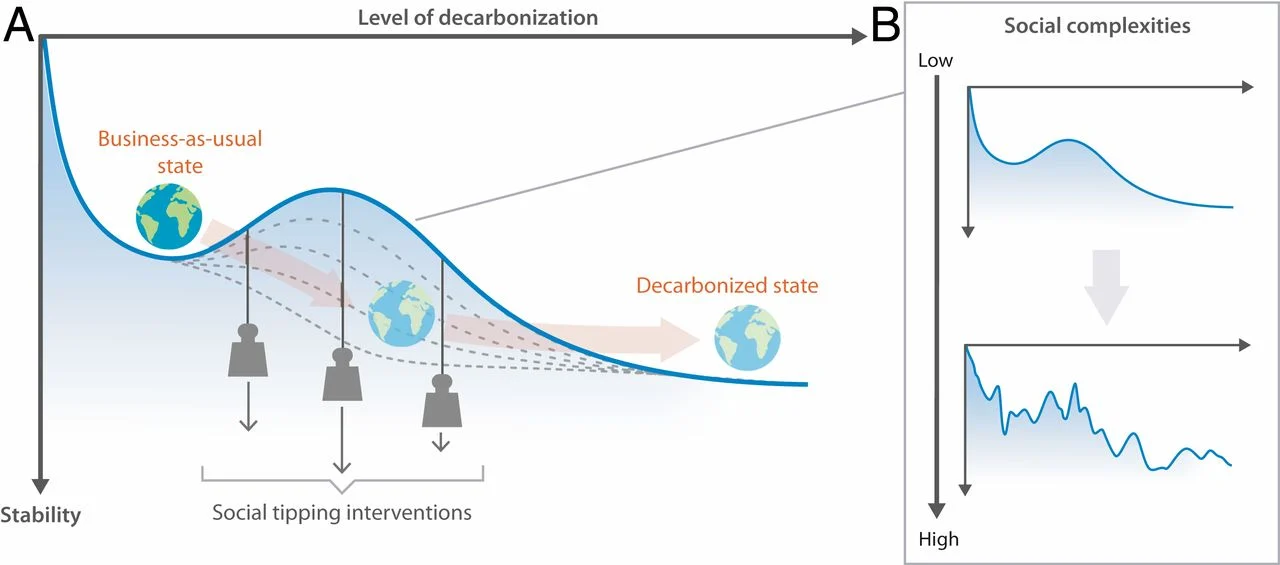
Tipping Point science is a wide and thriving research field. Graphic scribe live recorded at the 2022 Tipping Points conference in Exeter, by Sarah Manley and Guillaume Lagane.
Tipping points
The concept of ‘tipping points’ was popularised by the author Malcolm Gladwell in his 2000 book: “The Tipping Point: How Little Things Can Make a Big Difference”, describing the phenomena as “when an idea, trend, or social behaviour crosses a threshold, tips, and spreads like wildfire”.
Scientists have discovered such dynamics can be found across a wide range of domains in natural and social systems with different temporal and spatial scales. Usage of the term varies, from the more metaphorical sense of an initial spark that spreads like wildfire, to abrupt ecological regime shifts, to critical transitions in bifurcation theory in mathematics. An increasingly widely adopted formulation in Earth and climate sciences is
A tipping point is the threshold at which a small perturbation causes a large qualitative change in the future state of a complex system,
which is similarly applicable for socio-economic systems. This nonlinear response („the outcome is not proportional to the input“) usually occurs when there is a strong self-reinforcing feedback amplifying the initial perturbation up – a small change in A leads to a change in B which in turn leads to more change in A et cetera.
For many processes, this runaway effect can happen quite rapidly (i.e. faster than the perturbing force), like seagrass transitions or fisheries collapse. However, these dynamics can also unfold on much longer time scales such as in the case of ice sheet disintegration, where a continued self-accelerating melt is expected even in the absence of further global warming.

Selection of climate and social tipping elements, with typical spatial and temporal scales. From Winkelmann, Donges, Smith, Milkoreit et al., Ecological Economics 192, 107242 (2022). Click on image links to the original publication.